
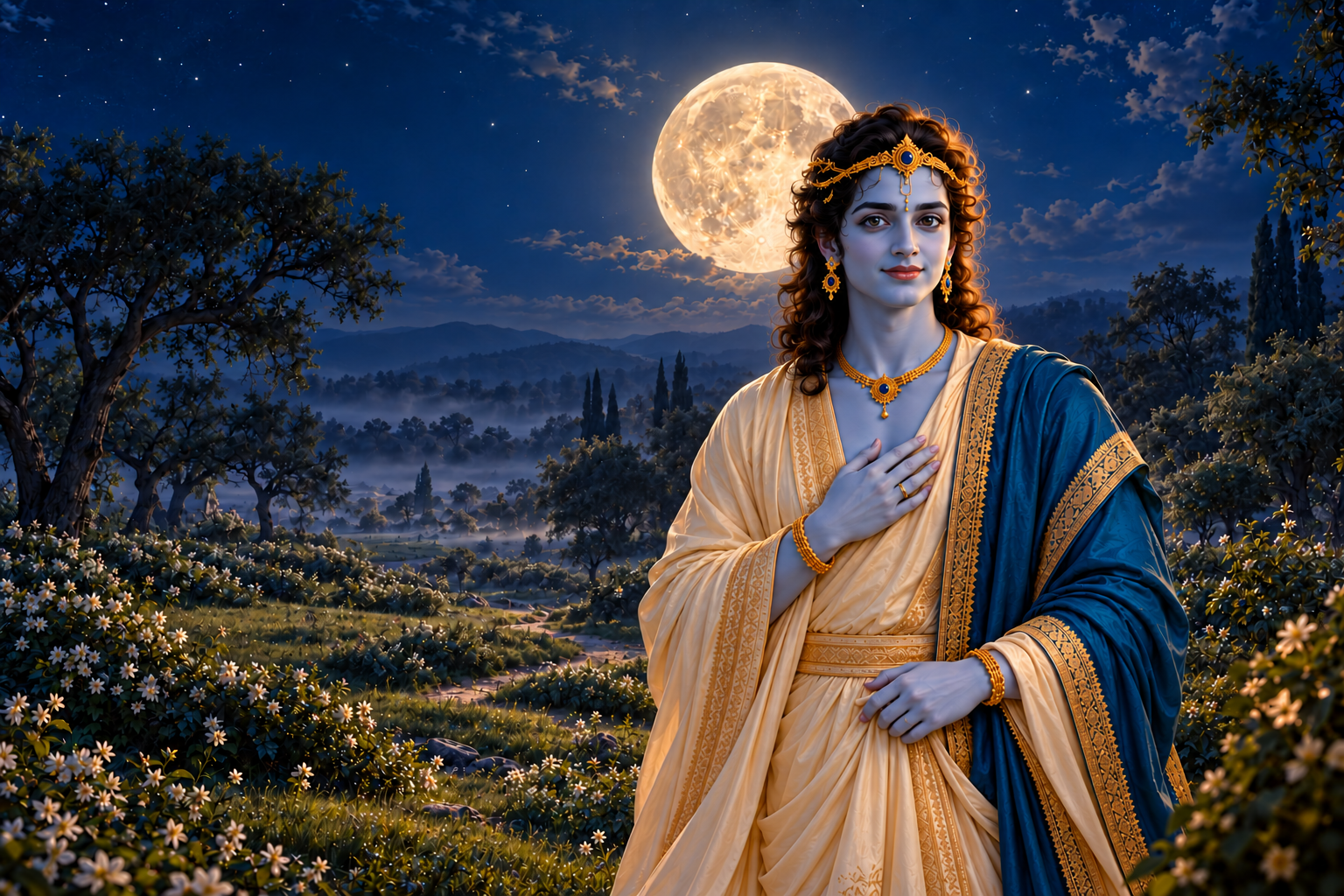
His life · His wisdom · His enduring presence
The Journey ofKrishna
From the first guarded night
to a presence beyond time.
Fourteen chapters through his life,
the people who loved him,
and the wisdom they carry.
One life.
An immense world.
An enduring story.
Follow the golden thread
Every chapter, a world.
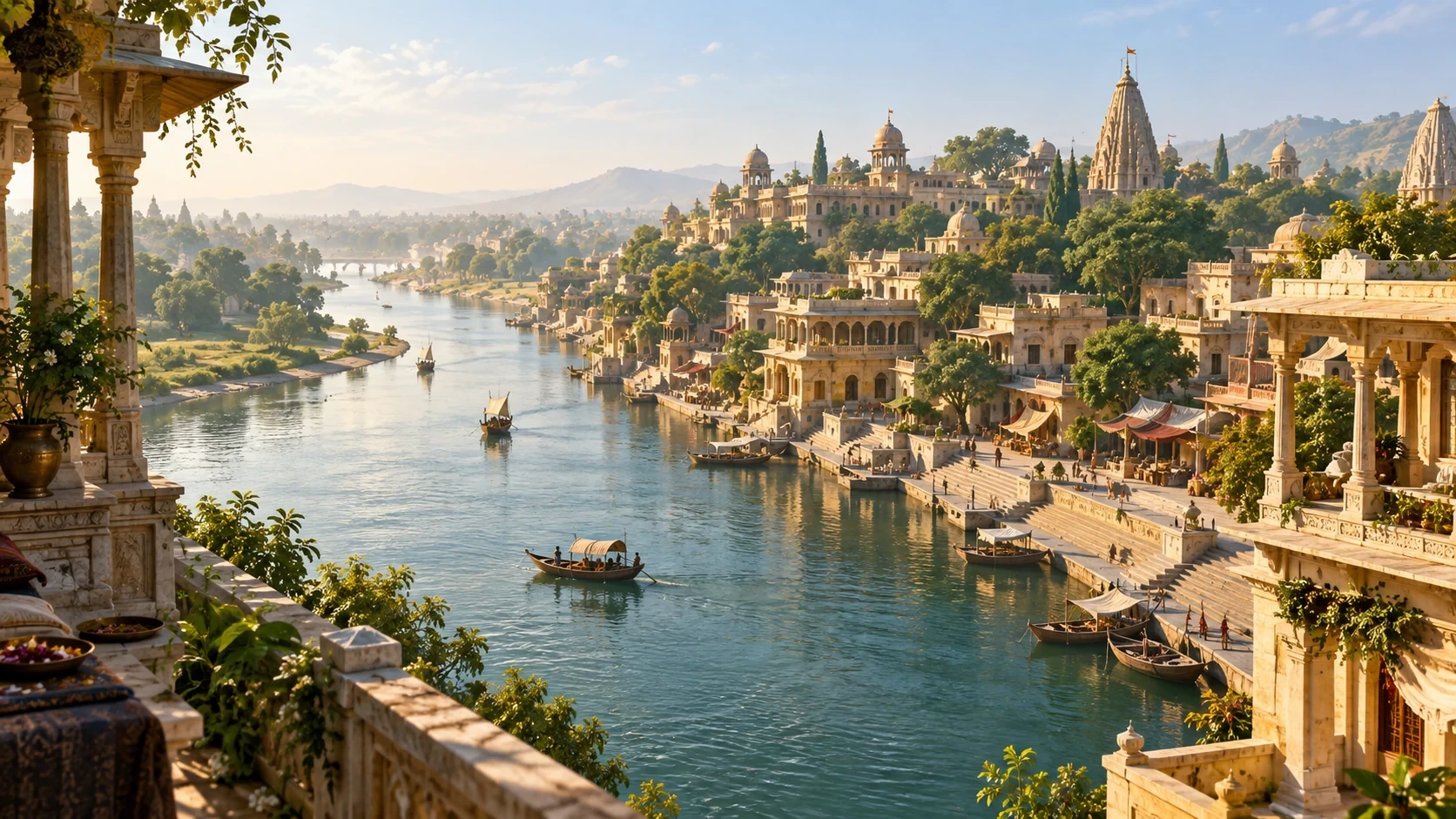
Chapter 01 Before the Dawn
Before Krishna
A city, a marriage, a prophecy. In Mathura, Devaki and Vasudeva face the long night before Krishna’s birth.
Read This ChapterTHE FOURTEEN CHAPTERS
The complete story, preserved.
Read deeply. Return whenever you wish.
Choose your chapter
- 01Before Krishna
- 02The Birth of Krishna
- 03The Child of Gokul
- 04Vrindavan
- 05Protector of Braj
- 06Radha & Krishna
- 07Return to Mathura
- 08From Mathura to Dwarka
- 09Krishna, Rukmini & the House of Dwarka
- 10Krishna & the Pandavas
- 11Kurukshetra & the Bhagavad Gita
- 12Uddhava & the Final Teachings
- 13The Final Chapter
- 14Krishna Beyond Time
A visual introduction to the published chapters. Textual sources, later traditions and artistic interpretations remain distinguished within each chapter.
The Krishna Experience · Chapter one
Before Krishna
A city. A marriage. A prophecy.
And the long night before a birth.
The world
Mathura
before the storm.
Before Krishna’s birth, Mathura stood at the heart of the Yadava world.
Mathura enters this story with a past of its own. In the Bhagavata Purana, Shurasena rules from the city within the lineage of Yadu. The royal families who gather around Devaki and Vasudeva belong to a network of related houses, with marriages and obligations reaching beyond any single palace.
Before there is a prophecy, there is a wedding. To begin here is to encounter a world still moving through its ordinary commitments: a daughter leaving her family home, a marriage joining households, relatives accompanying the departure. The crisis will arise within those relationships.
A beginning
Devaki &
Vasudeva
Before they were remembered as parents, they were newly married.
Devaki leaves her father’s household as Vasudeva’s bride. Their marriage places them at the meeting point of already connected royal families. They enter the narrative with names, parents and relationships, before the story asks them to endure what will make them remembered.
The accounts tell us far more about the crisis that follows than about their private life before it. They preserve no courtship conversation for us to reconstruct. What they do give is a public beginning: a marriage acknowledged by the family, a departure accompanied with honour, and a future not yet reduced to a prophecy.
Celebration
The wedding
procession
Kamsa holds the reins.
The departure is a royal celebration. The Bhagavata describes gifts, attendants and accompanying chariots; conches, horns and drums mark the occasion. Devaka sends his daughter into married life with a public display of generosity.
At the reins is Kamsa. The text says that he drives to please Devaki. In this moment he performs an act of family honour, accompanying the newly married couple himself. His hands guide the vehicle that carries them away.
Mathura was celebrating a marriage.
Before the journey ended,
a prophecy would change everything.
The interruption
The prophecy
The eighth child.
Devaki’s eighth child will be the cause of Kamsa’s death.
An unseen voice announces that Devaki’s eighth child will bring about Kamsa’s death. In the procession accounts of the Bhagavata and Vishnu Puranas, the warning has no visible speaker. It enters a celebration concerned with the couple’s future and makes Kamsa confront his own.
The announcement identifies a relationship and a place in a sequence of births. It does not accuse Devaki of an act against him. She has done nothing to turn this wedding journey into a threat. Yet she is the person now within his reach.
A rupture
The sword drawn
Fear becomes a choice to harm.
Kamsa draws his sword against Devaki. The warning concerned a future child; his immediate answer is to threaten the woman whose wedding chariot he has been driving. Kinship offers no protection at the moment it is most needed.
Vasudeva intervenes with speech. He cannot make the weapon disappear or command Kamsa to release her. He must find a reason that can interrupt the act before it is carried out.
Words against a sword
Vasudeva’s promise
To save Devaki now, he promises what no parent should have to promise.
When his first appeals fail, Vasudeva looks for another way to save Devaki. He cannot promise that no child will threaten Kamsa. He offers instead to place the children born to them within Kamsa’s reach.
The assurance is accepted. Devaki is spared. The immediate crisis ends with a life preserved and a future placed under a terrible condition. The couple can continue home, but they cannot continue as though the warning had never been heard.
Power without trust
Fear takes
the throne.
What happens to a kingdom
when its ruler trusts no one?
A warning about one child becomes suspicion of an entire world.
The narrow reprieve cannot hold once Kamsa begins to suspect more than the eighth child. In the Bhagavata account, Narada’s disclosure makes the family and its allies appear to him as participants in a divine purpose against his rule.
Kamsa’s answer extends beyond Devaki and Vasudeva. He imprisons his own father, Ugrasena, and takes power. A fear first directed at a future child becomes a reason to seize authority over people already around him.
The world narrows
The prison
A marriage that began in movement is held in confinement.
Devaki and Vasudeva are confined. The movement that began with a wedding departure gives way to a life whose boundaries are enforced by someone else. They cannot simply leave, take their family elsewhere or decide who may approach them.
The accounts make captivity concrete in different ways. The Bhagavata speaks of iron bonds. The Harivamsha describes guarded inner apartments and close watch over Devaki’s pregnancies. In either telling, the household has been placed under the ruler’s control.
Loss
The six children
Six births. Six lives taken.
Kamsa kills the first six children born to Devaki. The narrative records repeated births and repeated loss. We do not depict the acts. The fact itself requires time and attention.
These children are often encountered as a number on the way to the eighth. But each birth belongs to the lives of Devaki and Vasudeva. The story has not yet reached deliverance, and the parents’ suffering cannot be reduced to preparation for it.
A hidden passage
The seventh
pregnancy.
What seems lost in Mathura is carried into another life.
After the six losses, Devaki carries a seventh child. The Bhagavata identifies this presence with Ananta, also called Shesha. The child will be known as Balarama, Krishna’s elder brother.
The narrative now reaches beyond the place of confinement. Rohini, another wife of Vasudeva, is sheltered in Nanda’s household in the pastoral region. In the Bhagavata’s telling, Yogamaya is directed to transfer the pregnancy from Devaki to Rohini.
The threshold
The eighth
Devaki is expecting again.
The seventh child has been preserved beyond Kamsa’s knowledge, but her confinement has not ended. The eighth pregnancy approaches within the same unequal circumstances that have already cost the family so much.
In the Bhagavata’s telling, divine presence gives Devaki a radiance that Kamsa recognizes with alarm. What a devotional reader understands as an arrival of hope becomes, for him, renewed evidence of danger.
Not yet the birth.
The breath before it.
Carry this with you
Fear asks how much of the future we can control.
This story asks what we refuse to surrender while we wait.
Next chapter · 02
The Birth of Krishna
A divine arrival
Begin Chapter 2