
His wisdom · The enduring dialogue
श्रीमद्भगवद्गीता
The Bhagavad
Gita.
A conversation on duty, action,
self, devotion and freedom.
Spoken on a battlefield. Read across centuries.
Before the first verse
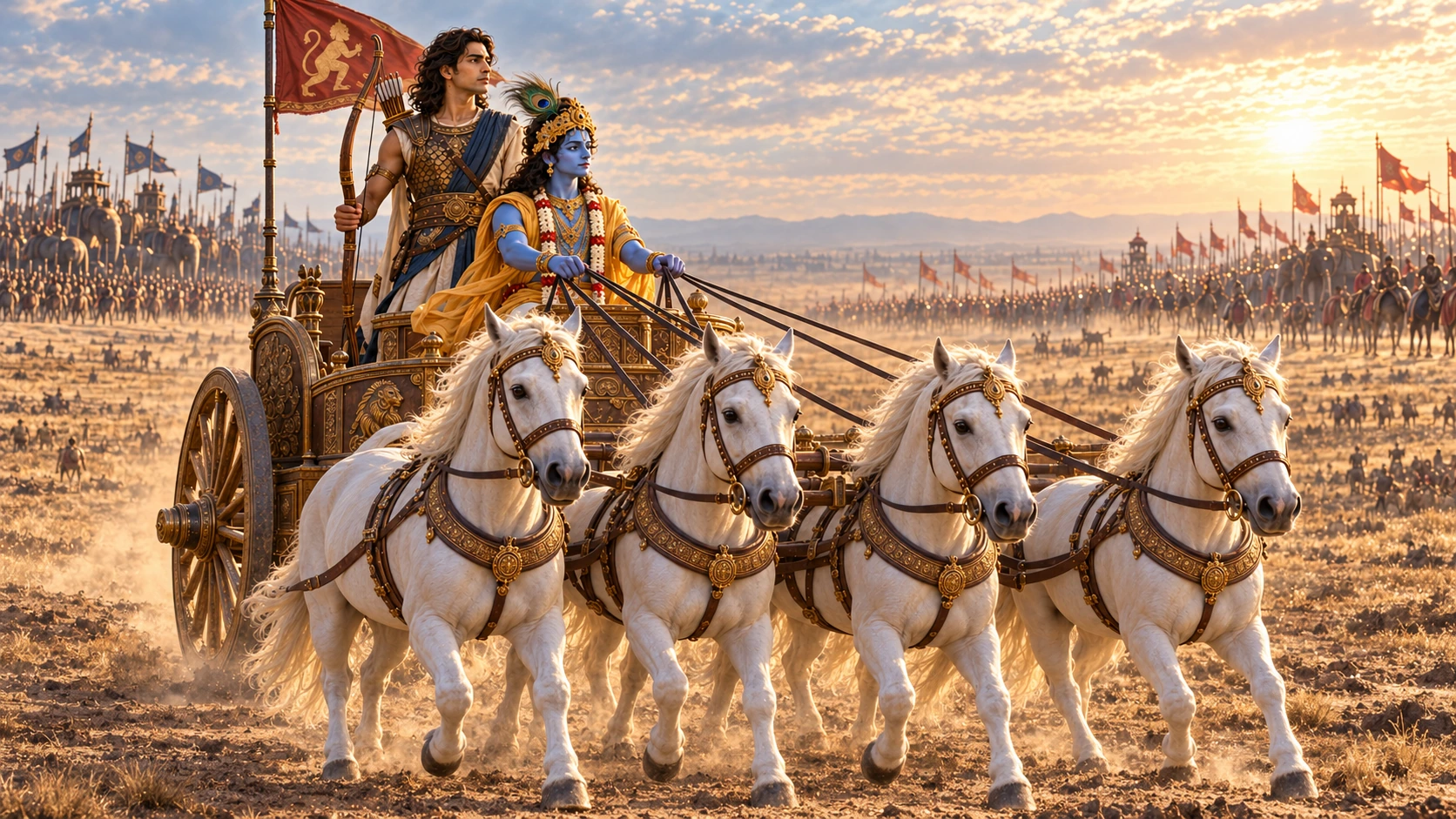
The chariot
comes to
a halt.
An opening in the Mahābhārata, within the Bhīṣma Parva.
The Bhagavad Gita begins inside a crisis. Two armies have assembled at Kurukshetra. On both sides stand members of the same extended family, joined by teachers, friends, allies and rulers. Years of rivalry and failed peace have brought them here.
Arjuna, a Pandava warrior, asks Krishna to place their chariot between the armies. Krishna is his charioteer. What Arjuna sees is not simply an enemy force. He recognises people to whom he owes affection and respect. Victory would mean their deaths. His body falters, his bow slips, and the reasons for fighting no longer feel sufficient.
His hesitation is moral as well as personal. He questions the value of a kingdom bought at such a cost, fears the destruction of families and wonders whether refusing to fight would be better. The dialogue begins because familiar answers have ceased to hold. In Chapter 2 he asks Krishna to teach him.
The conversation reaches beyond the immediate decision: into the self and the body, action and its consequences, knowledge, meditation, devotion and liberation. Yet the battlefield never becomes irrelevant. Krishna speaks to this person, in this situation. A verse lifted out of the conversation can sound simpler, safer or more absolute than it does in its place.
Read with that tension intact. These chapter companions distinguish the Sanskrit text, an original English translation and editorial interpretation. They introduce the argument without asking you to forget the difficult world in which it is spoken.
Context: Bhagavad Gita 1.20–47 and 2.1–10. Read the opening.
Read the Gita
Eighteen chapters.
One unfolding conversation.
Begin in sequence, or enter through any of eighteen complete reading companions. Every chapter remains connected to the whole.
अर्जुनविषादयोगः
Arjuna-viṣāda-yoga
Arjuna’s sorrow
What happens when duty becomes unbearable?
47 verses · Read the chapterसाङ्ख्ययोगः
Sāṅkhya-yoga
The ground of understanding
What can remain steady when everything changes?
72 verses · Read the chapterकर्मयोगः
Karma-yoga
The discipline of action
How can I act without being bound by action?
43 verses · Read the chapterज्ञानकर्मसंन्यासयोगः
Jñāna-karma-sannyāsa-yoga
Knowledge and the renunciation of action
How does understanding transform what I do?
42 verses · Read the chapterकर्मसंन्यासयोगः
Karma-sannyāsa-yoga
Renunciation within action
Must I leave the world to be free?
29 verses · Read the chapterध्यानयोगः
Dhyāna-yoga
The discipline of meditation
How does a restless mind learn to stay?
47 verses · Read the chapterज्ञानविज्ञानयोगः
Jñāna-vijñāna-yoga
Knowing and realising
What does it mean to know the divine?
30 verses · Read the chapterअक्षरब्रह्मयोगः
Akṣara-brahma-yoga
The imperishable Brahman
What endures at the threshold of death?
28 verses · Read the chapterराजविद्याराजगुह्ययोगः
Rāja-vidyā-rāja-guhya-yoga
The royal knowledge and deepest mystery
Can ordinary life become an offering?
34 verses · Read the chapterविभूतियोगः
Vibhūti-yoga
The divine manifestations
Where might I recognise the divine in the world?
42 verses · Read the chapterविश्वरूपदर्शनयोगः
Viśvarūpa-darśana-yoga
The vision of the universal form
What happens when the whole exceeds what I can bear?
55 verses · Read the chapterभक्तियोगः
Bhakti-yoga
The way of devotion
What does devotion ask of a life?
20 verses · Read the chapterक्षेत्रक्षेत्रज्ञविभागयोगः
Kṣetra-kṣetrajña-vibhāga-yoga
The field and its knower
What is experienced, and who is the one who knows?
35 verses · Read the chapterगुणत्रयविभागयोगः
Guṇatraya-vibhāga-yoga
The three qualities of nature
What shapes the way I think, desire and act?
27 verses · Read the chapterपुरुषोत्तमयोगः
Puruṣottama-yoga
The supreme person
What lies beyond the perishable and imperishable?
20 verses · Read the chapterदैवासुरसम्पद्विभागयोगः
Daivāsura-sampad-vibhāga-yoga
The divine and destructive dispositions
Which qualities make freedom possible?
24 verses · Read the chapterश्रद्धात्रयविभागयोगः
Śraddhātraya-vibhāga-yoga
The threefold character of faith
How does what I trust shape who I become?
28 verses · Read the chapterमोक्षसंन्यासयोगः
Mokṣa-sannyāsa-yoga
Renunciation and freedom
After understanding, how shall I choose to act?
78 verses · Read the chapterChapter 13 follows the 35-verse numbering, including Arjuna’s opening question. Some editions count 34. Traditional chapter titles also vary. Our textual conventions.
Explore by theme
Follow a thread.
Fourteen ways to move across the conversation without losing its context.
Action
The act matters. So does the attachment carried into it.
2.47 · Action and its fruits A four-part instruction that includes a warning against inaction.3.19 · Act without clinging Required action and freedom from attachment belong together.What are you seeking?
Begin with a question.
A small set of passages for a considered first step.
Direction
Begin where Arjuna can no longer decide what is right.
2.7 · Ask clearly An admission of uncertainty opens the teaching.18.63 · Reflect before choosing The response comes after consideration of the whole.These are curated reading paths, not personal spiritual prescriptions. Follow each passage back into its chapter.
Find a passage
Return to the words.
Search all eighteen chapters and 701 verses by reference, Sanskrit, transliteration, English or theme.
A note on this reading
A conversation,
kept open.
All eighteen chapter companions are complete. Read every verse here in Sanskrit, IAST transliteration and original King of Dwarka English. Selected passages offer a closer reading, while sources and editions remain available for further study.
Text, translation & sources